AI Omnichannel Communication & Triage System

The Customer Wasn't Ignored. They Were Just Answered by the Wrong System Three Days Later

Customer Communications

A service company was losing customer inquiries across four disconnected channels — phone, email, chat, and WhatsApp — with no single view of who needed a response. We built an AI system that unifies every channel, triages by urgency, and routes the right inquiry to the right person automatically.

Get a Free Automation Audit

Intro

Short intro

Most service businesses don't lose customers because they're unresponsive — they lose them because they're responsive in the wrong order. A request that arrives by WhatsApp sits unread while staff clears the email inbox; a phone call that needed a five-minute answer gets a written reply two days later because nobody owns the channel it came through. This case is about what happens when every channel reports to one system instead of competing for the same attention.
Kubera AI case dashboard for customer communications automation

About

About the project

A facility-services company in Finland providing maintenance, cleaning, and property-support services to both commercial clients (offices, property managers) and residential customers (apartment associations, individual homeowners), with a team of 12 field staff and 2 office coordinators. Inbound communication arrived through four channels — phone, email, a website contact form, and WhatsApp (increasingly the preferred channel for younger residential clients) — each checked separately, by whoever had a free moment.

Starting point

Initial situation

This is a structural problem common to service businesses with multiple inbound channels and limited office staff, not a failure specific to this company:

  • No unified inbox: each channel lived in its own silo — email in Outlook, WhatsApp on a shared phone, the contact form emailing a generic inbox, and phone calls logged nowhere beyond whatever the person who answered remembered to write down
  • No urgency triage: a burst pipe reported by WhatsApp and a routine "can you send an invoice copy" email were treated with the same response priority — first-in-first-handled, regardless of what was actually urgent
  • Response time varied wildly by channel: phone calls during office hours got answered quickly; WhatsApp messages, email, and the contact form could sit for hours or, during a busy week, a full day or more, because no channel had an owner responsible for clearing it
  • No cross-channel customer history: if a client called about something they'd already emailed about, the person answering the phone had no visibility into that email — leading to the customer re-explaining the issue, or worse, two staff members responding with conflicting answers

Goal

Project goal

The team wasn't failing to communicate — they were communicating reactively, in the order channels happened to be checked, rather than in the order client need actually demanded.

  • Bring all four channels into a single, unified inbox with one view of every open inquiry
  • Automatically triage incoming messages by urgency, not by arrival order or channel
  • Route each inquiry to the right person (or resolve it automatically, where possible) without manual sorting
  • Give every customer a consistent response time, regardless of which channel they choose to use

Strategy

Automation strategy

The fix isn't "answer faster on each channel individually" — that just optimizes four separate bottlenecks. The fix is removing the channel as the variable that determines response priority:

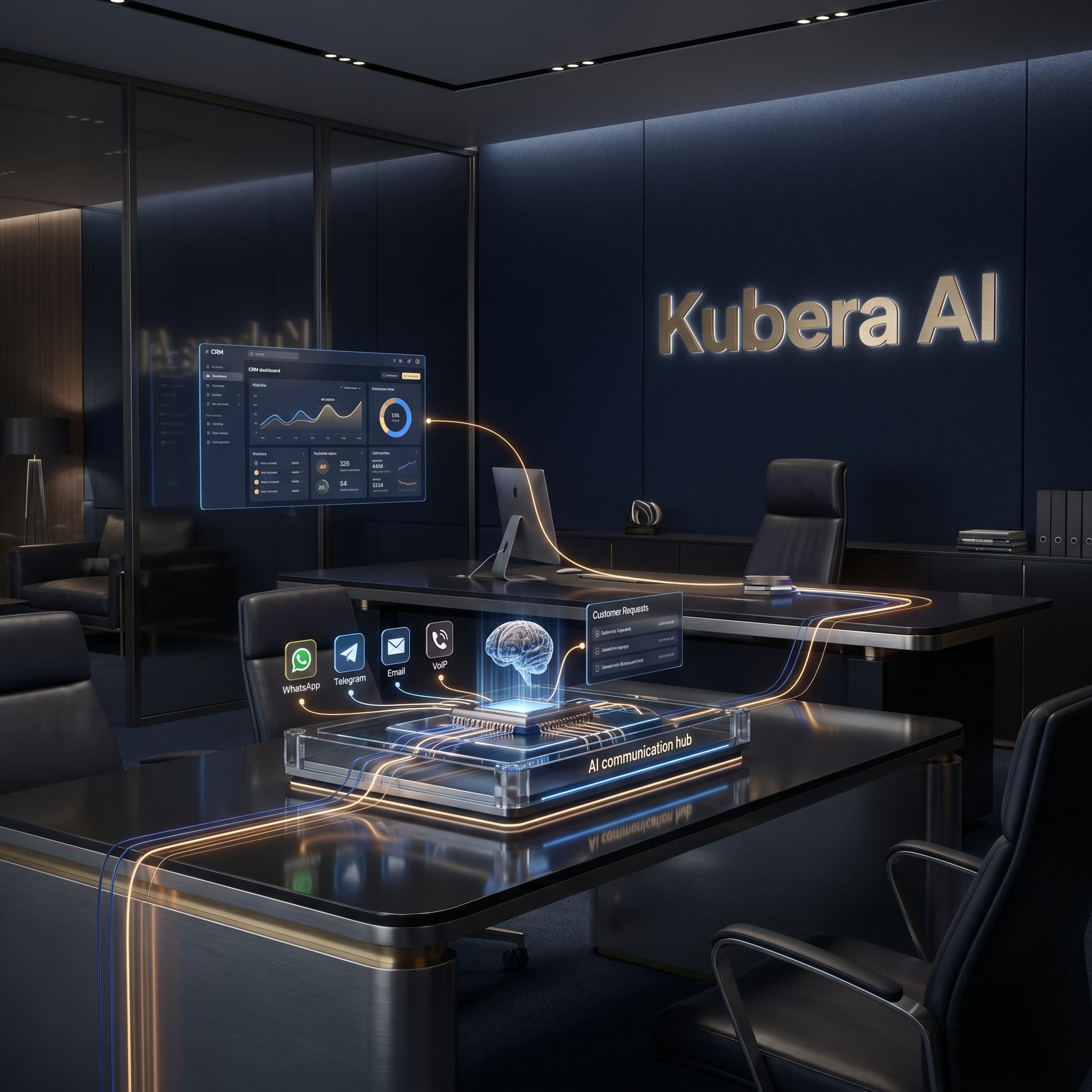
  • Layer 1 — Unification. Every inbound message — phone (transcribed), email, web form, WhatsApp — lands in one system, tagged with channel, sender, and full prior history with that customer across all channels.
  • Layer 2 — Urgency triage. The AI agent classifies each inquiry by urgency and type (emergency/safety issue, time-sensitive request, routine question, billing/admin) using both keyword and context signals — a WhatsApp message mentioning a leak gets flagged ahead of an email asking about invoice formatting, regardless of which arrived first.
  • Layer 3 — Routing and auto-resolution. Routine, well-defined requests (invoice copies, appointment confirmations, standard FAQs) are answered directly by the AI agent. Anything requiring judgment or field action is routed to the correct staff member based on client relationship, service area, and current workload — not whoever happens to check that inbox next.
  • Layer 4 — Cross-channel continuity. Because every interaction is logged against one customer record, a phone call referencing an earlier WhatsApp message doesn't require the customer to re-explain anything — staff sees the full thread regardless of which channel each piece came through.

Architecture

Workflow architecture

[Inbound: Phone (transcribed) / Email / Web Form / WhatsApp]
        ↓
[AI Agent — Unify + Tag (channel, sender, history)]
        ↓
[Urgency & Type Classification]
        ↓
   ┌───────────────┬───────────────┬───────────────┐
   ↓               ↓               ↓               ↓
[Emergency]   [Time-Sensitive] [Routine/FAQ]   [Billing/Admin]
   ↓               ↓               ↓               ↓
[Immediate     [Routed to      [Auto-resolved   [Routed to
 Staff Alert    Available        by AI Agent]     Office
 + Field        Staff by                          Coordinator]
 Dispatch]      Area/Load]
        ↓
[CRM Entry: Unified Customer Record, All Channels]
        ↓
[Owner Dashboard: Response Time by Channel/Urgency,
 Auto-Resolution Rate, Unresolved Queue]

Implemented

What was implemented

  • Unified inbox merging phone (via call transcription), email, website contact form, and WhatsApp into one system
  • AI-driven urgency and category classification applied to every inbound message, independent of channel
  • Automated routing logic assigning time-sensitive and field-related requests to available staff based on service area and current workload
  • Auto-resolution for routine, well-defined requests (invoice resends, appointment confirmations, standard FAQs) without staff involvement
  • Unified customer record consolidating every interaction across all four channels into one history, visible to whoever picks up the next inquiry
  • Emergency-flagging logic that immediately alerts available field staff for safety-relevant issues (leaks, lockouts, heating failures), bypassing the standard queue entirely
  • Owner / coordinator dashboard tracking response time by channel and urgency tier, auto-resolution rate, and current unresolved queue size

Tools / Stack

Tools / Stack

  • n8n (orchestration)
  • OpenAI / GPT-4o (classification, triage, and auto-response logic)
  • Telephony integration with call transcription (for voice-to-text logging and AI handling of routine calls)
  • WhatsApp Business API
  • Email parsing and routing layer (Outlook / Gmail integration)
  • Website contact form webhook integration
  • PostgreSQL (unified customer record + interaction history)
  • Staff routing / dispatch logic tied to service-area and workload data
  • Dashboard layer for response-time and queue monitoring

Economics

Business economics

Modeled on this company's profile (12 field staff, 2 office coordinators, 4 inbound channels, mixed commercial / residential client base) — every figure below follows a calculation any multi-channel service business can re-run on its own inquiry volume and labor cost.

  • The cost of fragmented triage: estimated inbound volume across all channels: ~450–500 inquiries/month. Without unified triage, office coordinators spent an estimated 25–30% of their working time simply checking, sorting, and manually routing messages across four separate systems — not resolving issues, just figuring out what needed attention and who should handle it. At a fully loaded coordinator cost of roughly €28–32/hour in the Finnish market, 2 coordinators spending ~27% of a standard 160-hour work month on triage alone represents roughly €2,400–2,750/month in labor cost spent on sorting, not solving.
  • Auto-resolution impact: an estimated 30–35% of inbound inquiries are routine and well-defined (invoice copies, appointment confirmations, standard service FAQs) — currently requiring a staff member's time even though the answer is the same every time. Auto-resolving this share through the AI agent removes roughly 140–170 inquiries/month from the manual queue entirely. At an average handling time of ~6–8 minutes per routine inquiry, that's roughly 15–22 staff-hours/month freed, worth approximately €420–700/month at coordinator labor cost.
  • Response-time consistency and its downstream effect: before unification, average response time on the slowest channel (WhatsApp / web form during busy weeks) ran 24–48+ hours, against under 1 hour for phone calls during office hours — a gap large enough that some residential clients reported choosing a competitor for time-sensitive requests simply because the response came too slowly through their preferred channel. For a service business, a delayed response to a time-sensitive issue (a heating problem, a lockout, a leak) carries real retention risk — losing even 2–3 residential service contracts per year to a slow-response experience, at an average annual contract value of ~€800–1,200, represents €1,600–3,600/year in avoidable churn.
  • Combined monthly impact, conservative estimate: coordinator time reclaimed from manual triage: +€2,400–2,750/month in redirected labor capacity. Auto-resolution time savings: +€420–700/month. Reduced client churn from inconsistent response times: roughly €130–300/month amortized from the annual churn estimate above. Combined: a service business of this size can realistically reclaim the equivalent of half a coordinator's working capacity per month, without adding staff.

Results

Expected results

  • All four channels consolidated into one inbox with one priority order, regardless of arrival channel
  • Response time consistency across channels — no more fast on the phone, slow on WhatsApp gap
  • 30–35% of inbound volume auto-resolved without staff time, freeing roughly 15–22 coordinator-hours/month
  • Emergency / safety-relevant inquiries flagged and routed to available field staff immediately, independent of channel
  • One customer record per client across all channels, eliminating repeated explanations and conflicting responses
  • Owner / coordinator dashboard showing response time by urgency tier and channel, replacing a vague sense of we're behind with an actual, trackable queue size

Value

What the business gets

  • A single source of truth for every inbound inquiry, regardless of which of the four channels it arrived through
  • A triage system that prioritizes by actual urgency, not by which inbox happened to be checked first
  • Meaningful office-staff capacity freed from manual sorting and routine-response handling, without adding headcount
  • A consistent client experience that doesn't penalize customers for choosing WhatsApp over a phone call, or vice versa
  • Full visibility into where the communication system is actually under strain — by channel, by urgency tier, by time of day — instead of a general feeling that we're always behind on messages

Conclusion

Conclusion

This company wasn't failing to respond to customers — it was responding in the order four disconnected systems happened to surface requests, rather than in the order those requests actually needed attention. That distinction matters more than it sounds: an emergency sitting unread on WhatsApp while a routine invoice question gets handled by phone isn't a communication failure in the usual sense, it's a triage failure, and it's invisible until it costs a client. Unifying the channels and triaging by urgency rather than arrival order doesn't require more staff — it requires the four existing channels to report to one system instead of competing separately for the same limited attention.

CTA

Get a Free Automation Audit

Want to know how much staff time your business spends on channel triage instead of client work? We'll map your actual inquiry volume and response times across channels — no commitment, no generic pitch.

Get a Free Automation Audit