
AI Dispatch & Delivery Visibility System

The Dispatcher Spent Forty Minutes on the Phone Today, Just Telling Five Different People Where Their Delivery Already Is

Transport & Logistics

Most small transport and delivery operators run dispatch by phone — calling drivers for status, calling clients with updates, building routes by hand. This scenario shows how Kubera AI would design a system that automates routing, gives clients live visibility without a phone call, and frees the dispatcher from being the only source of truth.

Get a Free Automation Audit

Intro

Short intro

A client calls asking where their shipment is. The dispatcher puts them on hold, calls the driver, gets an answer, calls the client back. That's ten minutes, for information the driver's phone already knows. Multiply that by every client checking on every delivery, add routes built by hand every morning instead of optimized automatically, and a transport operation is spending a meaningful share of its day relaying information that should have updated itself. This Industry Scenario shows how Kubera AI would design the system that removes that relay.
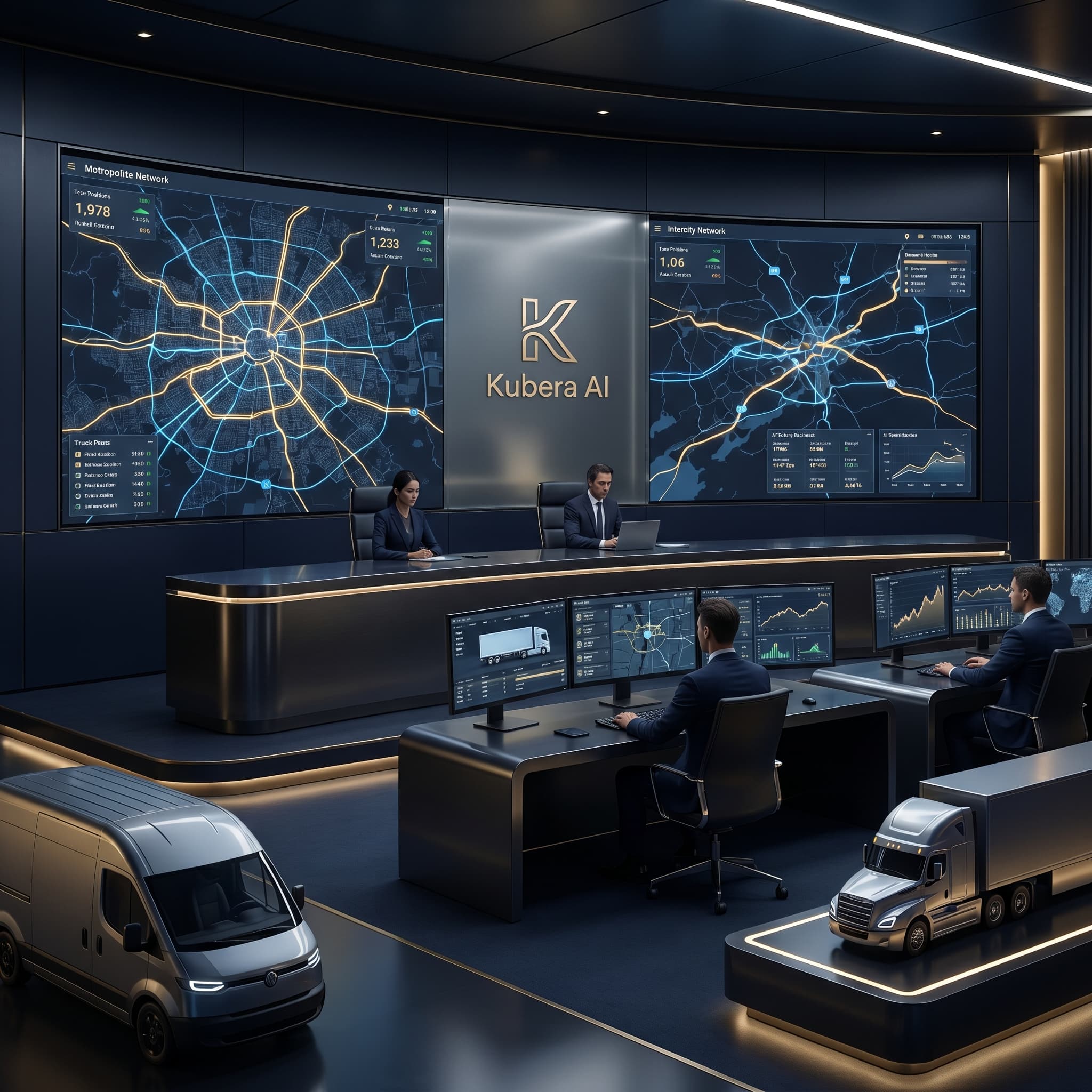
Kubera AI case dashboard for transport and logistics automation

About

About the project

This scenario is built around a small to mid-size transport or last-mile delivery operator — a fleet of roughly 15–40 vehicles, handling B2B deliveries, courier runs, or local distribution, with one or two dispatchers coordinating drivers by phone and a mix of spreadsheets or a basic routing tool for planning. This isn't a description of one specific client. It's the pattern Kubera AI sees across most regional transport and delivery operators who've grown past a one-person operation but don't yet run on an integrated dispatch and tracking system.

Starting point

Initial situation

None of what follows is a sign of poor operations. It's a structural pattern, and it shows up almost identically across fleets at this size:

  • Routes get built manually every morning. Without route-optimization software, a dispatcher typically plans each driver's stops by experience and judgment — workable, but it leaves real efficiency on the table. Industry research on route optimization commonly shows 10–20% reductions in total distance or driving time when manual routing is replaced by software that accounts for stop sequencing, traffic patterns, and vehicle capacity simultaneously — a gap that's invisible day to day but adds up to real fuel and labor cost over a month.
  • Status updates run through the dispatcher, not the system. A driver's location and delivery status typically only reach a written record when someone radios or calls it in, which means clients calling for an update force the dispatcher to interrupt a driver, get an answer, and relay it back — a three-step process for information that GPS and a delivery-confirmation step could surface instantly.
  • Where's my delivery calls eat a measurable share of the day. For an operator running a few dozen vehicles, status-check calls from clients commonly make up an estimated 20–30% of a dispatcher's daily call volume — none of which is dispatching, all of which is relaying information that already exists somewhere in the operation.
  • Proof of delivery is inconsistent. Without a structured capture process, delivery confirmation (signature, photo, timestamp) often depends on a driver remembering to do it and someone later transcribing it — leading to disputes over whether a delivery happened, when, and in what condition, that take real time to resolve after the fact.

Goal

Project goal

For an operator in this position, the goals Kubera AI would design around are:

  • Build daily routes automatically, accounting for stop sequencing, traffic, and vehicle capacity, instead of by hand each morning
  • Give clients live delivery visibility without needing to call the dispatcher
  • Capture proof of delivery consistently and automatically, removing disputes that depend on memory
  • Free the dispatcher's time from relaying status updates to actually managing exceptions — delays, breakdowns, re-routes — that genuinely need a human

Strategy

Automation strategy

The core idea: a driver's phone already knows where they are, and a delivery either happened or it didn't. The information clients are calling about already exists — it just isn't visible to anyone outside the dispatcher's head and the driver's memory. Making that information visible removes most of the relay work that currently passes for dispatch.

  • Step one — routes get optimized automatically, every morning. Daily routes would be generated by software accounting for delivery windows, stop sequencing, traffic conditions, and vehicle capacity — producing a route that's at minimum comparable to manual planning, and typically tighter, without a dispatcher spending the first hour of the day building it by hand.
  • Step two — clients see status without calling. Each client would get a live tracking link or automatic status updates (dispatched, in transit, estimated arrival, delivered) tied directly to GPS and driver app data — removing the need to call in for something the system already knows.
  • Step three — proof of delivery captured the same way, every time. A driver would log delivery confirmation (photo, signature, timestamp, geolocation) through a simple app step at the point of delivery, automatically attached to that order's record — removing the dependency on memory and giving both sides a clear, timestamped reference if a dispute ever comes up.
  • Step four — the dispatcher manages exceptions, not status relay. With routine status questions answered automatically, the dispatcher's time shifts toward the things that actually need a human: a vehicle breakdown, a missed delivery window, a re-route around an unexpected closure — the genuinely judgment-heavy 20% of the job, instead of the repetitive 80%.

Architecture

Workflow architecture

[Daily Orders/Deliveries Loaded]
        ↓
[AI Route Optimization — Stop Sequencing, Traffic, Vehicle Capacity]
        ↓
[Routes Assigned to Drivers via App]
        ↓
[Driver App — Live GPS + Status Updates as Stops Are Completed]
        ↓
   ┌───────────────┴───────────────┐
   ↓                               ↓
[Client Tracking Link/Status Updates Automatically] [Dispatcher Dashboard — Live Fleet View]
        ↓
[Delivery Completed — Photo/Signature/Timestamp Captured]
        ↓
[Order Record Updated Automatically]
        ↓
   ┌───────────────┴───────────────┐
   ↓                               ↓
[Routine — No Action Needed]   [Exception: Delay/Breakdown/ Re-route — Flagged to Dispatcher]
        ↓
[Owner Dashboard: On-Time Rate, Route Efficiency, Call Volume Deflected, Proof-of-Delivery Completion Rate]

Recommendation

Recommended Architecture

  • An automatic route-optimization layer generating daily routes based on delivery windows, stop order, traffic, and vehicle capacity, instead of manual planning each morning
  • A client-facing tracking system providing live status updates or a tracking link tied to actual GPS and delivery data, removing the need for status-check phone calls
  • A driver app integration capturing proof of delivery (photo, signature, timestamp, location) automatically at the point of delivery, attached to the order record without manual transcription
  • A dispatcher dashboard showing live fleet status and routine deliveries at a glance, with only genuine exceptions — delays, breakdowns, re-routing needs — surfaced for action
  • An owner-level reporting layer tracking on-time delivery rate, route efficiency, call volume deflected from the dispatcher, and proof-of-delivery completion

Tools / Stack

Tools / Stack

  • n8n (orchestrates route generation, status updates, and exception flagging)
  • A route-optimization engine (e.g., a dedicated logistics routing API, accounting for stops, traffic, and capacity)
  • Driver mobile app integration (GPS tracking, delivery confirmation capture)
  • OpenAI / GPT-4o (client-facing status communication and exception summarization for the dispatcher)
  • SMS/WhatsApp/email integration (client-facing tracking links and status updates)
  • PostgreSQL (delivery history, proof-of-delivery, and exception-log data layer)
  • A dispatcher and owner dashboard for fleet status, on-time rate, and efficiency metrics

Economics

Business economics

This is a conservative model based on a fleet of roughly 15–40 vehicles, with one or two dispatchers coordinating by phone and manual route planning. The numbers below come from publicly available logistics and route-optimization research — not from a specific client. Every operator should check these against its own fleet size, delivery volume, and fuel/labor costs before relying on them.

  • Industry research on route optimization commonly shows 10–20% reductions in total driving distance or time when manual route planning is replaced by optimization software accounting for stop sequencing, traffic, and vehicle capacity simultaneously.
  • For a fleet of 25 vehicles each driving an estimated 120 km/day, a conservative 10% reduction represents roughly 300 km/day saved across the fleet, or about 6,600 km/month assuming a 22-day working month.
  • At an estimated combined fuel and driver-time cost of roughly €0.35–0.45/km (fuel plus a portion of driver labor cost attributable to distance rather than stops), that represents a modeled €2,300–3,000/month in reduced operating cost — a meaningful figure, though one that depends heavily on this fleet's actual vehicle count, daily distance, and local fuel/labor costs.
  • Status-check calls from clients commonly make up an estimated 20–30% of a dispatcher's daily call volume for an operator at this scale. For a dispatcher fielding roughly 40–60 calls a day, that's an estimated 8–18 status-check calls/day, each taking roughly 3–5 minutes once the call-the-driver-and-relay-back step is included.
  • That represents roughly 0.5–1.5 hours/day, or 10–30 hours/month, spent purely relaying status information that live tracking would surface automatically. At a dispatcher labor cost of roughly €18–24/hour, that's a modeled €180–720/month in time that could shift to actual exception management instead.
  • Without consistent capture, delivery disputes (wrong item, damage claims, 'it was never delivered') typically take an estimated 30–60 minutes each to investigate and resolve, often involving a manager's time as well as the dispatcher's. For an operator handling even a handful of these disputes a month, automatic, consistent proof-of-delivery capture removes most of the investigation time entirely — this is highly dependent on a specific operator's current dispute volume and is best measured directly rather than generalized into one figure.
  • Reduced fuel and driving time from route optimization: roughly €2,300–3,000/month (modeled, dependent on actual fleet size, distance, and local cost per km)
  • Dispatcher time freed from status-relay calls: +€180–720/month (estimated)
  • Reduced time spent investigating delivery disputes: a real effect, but one too dependent on a specific operator's dispute history to express as a general figure

Results

Expected results

  • Daily routes generated automatically with an estimated 10–20% reduction in total driving distance or time compared to manual planning
  • Clients able to check delivery status through a live link instead of calling the dispatcher
  • The large majority of 'where's my delivery' calls eliminated, freeing dispatcher time for genuine exceptions
  • Proof of delivery captured consistently at every stop, reducing disputes that depend on memory or paper records
  • An owner-level dashboard showing on-time rate, route efficiency, and call volume deflected, instead of a general sense that 'dispatch is always busy'

Value

What the business gets

  • Routes that are tighter than manual planning most days, without a dispatcher spending the first hour of every shift building them by hand
  • A dispatcher whose time goes toward genuine exceptions instead of repeating the same status update to five different callers
  • Clients who get their own answer without needing to pick up the phone, which reduces friction in the relationship rather than just reducing call volume
  • A consistent, timestamped record of every delivery, which settles disputes in minutes instead of a back-and-forth investigation
  • A fleet operation that can take on more delivery volume without proportionally growing dispatch headcount

Conclusion

Conclusion

This setup makes the most sense for an operator that has grown past the point where one or two dispatchers coordinating by phone and spreadsheet still keep pace — usually somewhere past 15–20 vehicles, where route planning starts taking a visible chunk of the morning and the phone doesn't stop ringing with status checks. The tell is usually a dispatcher who can't take a break because they're the only source of truth for where every vehicle is, or a client relationship that runs on trust built through frequent reassurance calls rather than visibility the client could check themselves.

CTA

Get a Free Automation Audit

Want to know how much route efficiency and dispatcher time your fleet might be losing to manual coordination? We'll map your fleet size and delivery volume against this scenario — no commitment, no generic pitch.

Get a Free Automation Audit