AI Booking & Recall System

From Missed Calls to Booked Chairs: How One Clinic Stopped Losing Patients It Never Knew It Lost

Medical Clinics & Dental

A mid-size dental clinic was losing patients to missed calls and no-shows. We built an AI receptionist that answers 24/7, fills the schedule, and recalls patients automatically — recovering lost revenue without adding staff.

Get a Free Automation Audit

Intro

Short intro

Most dental clinics don't have a marketing problem. They have a response problem. Patients call, nobody picks up fast enough, and they book with the next clinic on Google. This case shows how a structured AI booking system closes that gap — and what it's actually worth in euros.
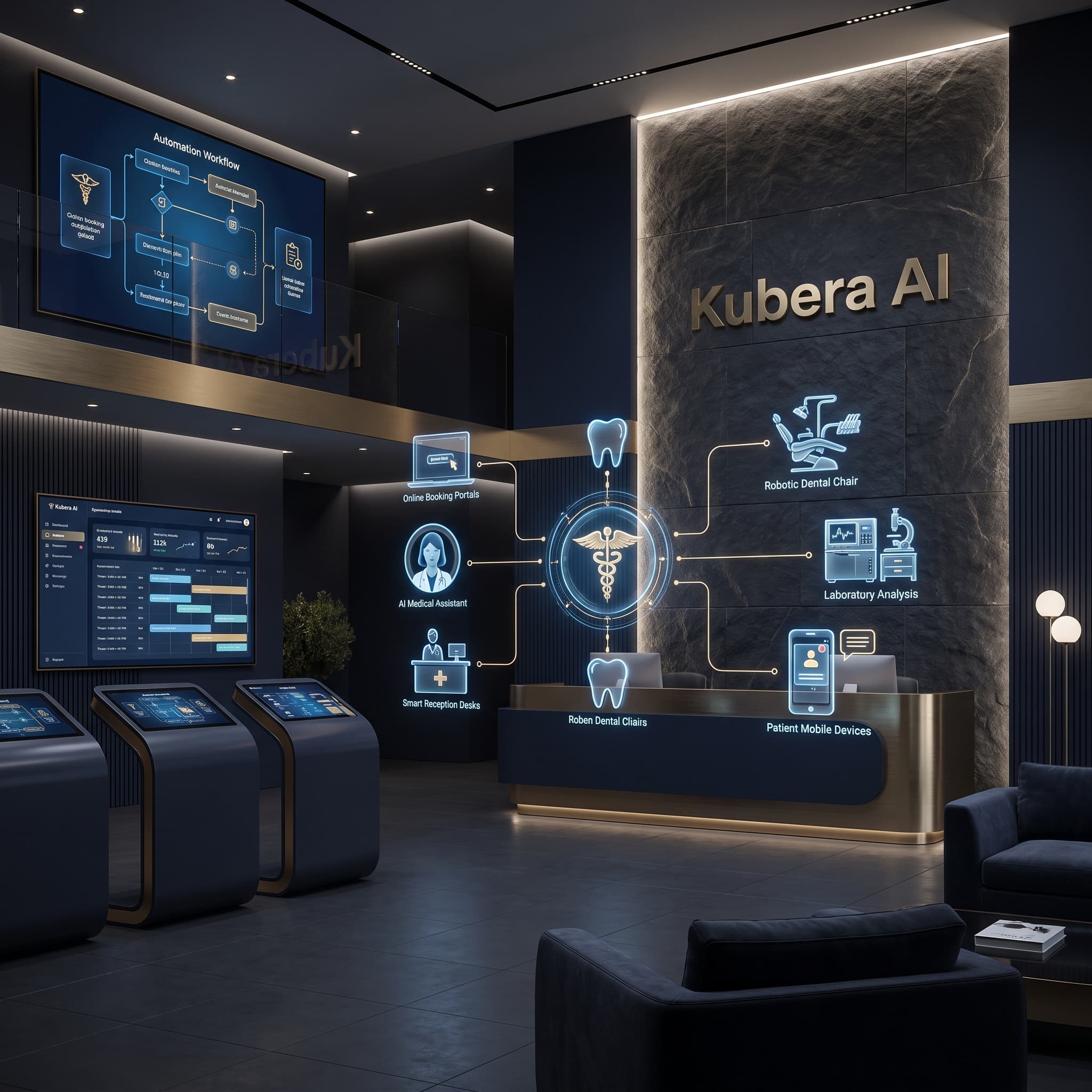
Kubera AI case dashboard for medical clinics and dental automation

About

About the project

A private dental clinic in Poland, 4 chairs, 3 dentists, front-desk staffed during business hours only. Like most clinics this size, the front desk handled bookings, rescheduling, and patient questions manually — by phone and occasionally WhatsApp. No call tracking, no structured recall system, no visibility into how many inquiries actually converted to appointments.

Starting point

Initial situation

The clinic operated on assumptions, not data — which is normal, because nobody manually logs missed calls. We worked backward from industry-standard benchmarks for clinics of this size to estimate the real gap:

  • Average inbound call volume: ~25–30 calls/day across 3 dentists
  • Front desk capacity: realistically answers 70–75% of calls during open hours (the rest go to voicemail or ring out during peak hours, lunch, or while staff handle in-person patients)
  • Calls outside business hours (evenings, weekends): effectively 100% missed — patients either leave a voicemail nobody returns same-day, or don't call back at all
  • Industry data on dental no-shows without active reminder systems: 15–20% no-show rate is standard

Goal

Project goal

Not "more leads." The clinic didn't need more demand — it needed to stop leaking the demand it already had, and protect chair-time that was already booked but unreliable due to no-shows.

  • Answer every inbound call/message, 24/7, without hiring additional front-desk staff
  • Convert a higher share of inquiries into confirmed bookings, same conversation
  • Cut no-show rate through automated, multi-touch reminders

Strategy

Automation strategy

We didn't build a chatbot that answers questions. We built a booking engine that closes the loop end-to-end: capture → qualify → book → confirm → remind → recover.

  • Layer 1 — Capture: every channel (phone via AI voice agent, website chat, WhatsApp, Instagram DM) routes into one system so no inquiry sits unanswered.
  • Layer 2 — Convert: the AI agent checks real-time calendar availability, asks the 3–4 qualifying questions a receptionist would ask, and offers concrete time slots — not "someone will call you back."
  • Layer 3 — Retain: after booking, the patient enters an automated reminder sequence (SMS + WhatsApp) at 48h, 24h, and 2h before the appointment, with a one-tap reschedule link instead of a cancellation by silence.

Architecture

Workflow architecture

[Inbound Channel: Call / WhatsApp / Web Chat / Instagram]
        ↓
[AI Agent — Intent & Urgency Detection]
        ↓
[Calendar Check — Real-time Availability]
        ↓
   ┌─────────────┴─────────────┐
   ↓                           ↓
[Slot Available]        [No Slot / Emergency]
   ↓                           ↓
[Book + Confirm]      [Priority Queue → Human Callback]
   ↓
[CRM Entry: Patient Record + Source + Treatment Type]
   ↓
[Reminder Sequence: 48h / 24h / 2h before appointment]
   ↓
[No-show? → Auto-reschedule offer]
   ↓
[Post-visit: Review request + Recall scheduling (6-month checkup)]

Implemented

What was implemented

  • AI voice agent for inbound calls (answers, qualifies, books, escalates emergencies to a human line)
  • WhatsApp + Instagram DM automation with the same booking logic
  • Live calendar sync — no double-booking, no manual back-and-forth
  • Automated reminder sequence with reschedule-by-tap (not reschedule-by-calling-back)
  • Lightweight CRM layer: every patient, every inquiry source, every treatment type, logged automatically
  • Recall automation: 6-month checkup reminders sent without staff involvement
  • Owner dashboard: daily view of inquiries, conversion rate, no-show rate — numbers the clinic never had before

Tools / Stack

Tools / Stack

  • n8n (orchestration)
  • OpenAI / GPT-4o (conversation engine)
  • Twilio or equivalent telephony (voice + SMS)
  • WhatsApp Business API
  • Google Calendar / clinic PMS integration
  • PostgreSQL (CRM layer)
  • Calendar-based reminder scheduler

Economics

Business economics

Numbers below are modeled on the clinic's profile (4 chairs, 3 dentists, ~25–30 calls/day) — not guaranteed results, but the calculation logic any clinic can re-run with their own numbers.

  • Missed-call cost: ~7 missed inquiries/day × ~22 working days = ~154 missed inquiries/month
  • Realistic inquiry-to-booking conversion if those calls had been answered: ~35–40% → ~55 potentially lost bookings/month
  • Average treatment value (mix of checkups, cleanings, fillings, consultations): ~€90–120/visit → estimated monthly revenue leakage from missed calls alone: ~€5,000–6,500
  • The system doesn't need to recover all of it to justify itself — recovering even 30–40% of this gap already outperforms the cost of the automation by several multiples.
  • No-show cost: without reminders, 15–20% no-show rate; with structured 3-touch reminders, industry-documented reduction to 5–8% no-show rate.
  • On ~500 monthly appointments at ~€100 average value, cutting no-shows from 18% to 7% recovers roughly €5,500/month in chair-time that would otherwise sit empty.

Results

Expected results

  • 24/7 inquiry coverage — no inquiry left unanswered overnight or on weekends
  • Estimated 25–35% increase in inquiry-to-booking conversion (capturing previously missed calls)
  • No-show rate reduction from ~15–18% to ~6–8% within 60–90 days of consistent reminder use
  • Full visibility: owner sees inquiry volume, source, and conversion rate daily instead of "a feeling that the phone doesn't stop ringing"
  • Recall system runs without staff time — checkup reminders become a passive revenue stream instead of a forgotten task

Value

What the business gets

  • A front desk that never sleeps, never gets sick, and never forgets to follow up
  • A real CRM instead of a paper appointment book or scattered WhatsApp threads
  • Direct, measurable control over two of the biggest hidden costs in any clinic: missed inquiries and no-shows
  • A system that scales with the clinic — adding a 4th or 5th dentist doesn't require hiring another receptionist

Conclusion

Conclusion

This clinic didn't have a demand problem. It had a leak. Most clinics do — they just don't have the data to see it, because nobody logs a call that was never answered. The fix isn't "more marketing." It's closing the gap between the patients already trying to book and the patients who actually get an appointment confirmed. That gap, once closed, pays for the system many times over.

CTA

Get a Free Automation Audit

Want to know your clinic's actual missed-call and no-show cost? We'll map it using your real numbers — no commitment, no generic pitch.

Get a Free Automation Audit

Related use cases

Adjacent use case pages

These links keep the case study connected to the new use-case cluster without claiming the same project or client.