AEO-Optimized Landing Page with AI Sales Chat

Your Best Customer Already Asked ChatGPT About You. It Just Didn't Mention Your Name.

Landing Page GPT-NTI

A B2B service provider was invisible to ChatGPT and Perplexity, and its existing landing pages converted poorly because visitors had no way to get a direct answer without filling out a form. We built an AEO-structured page that AI engines actually cite, paired with an AI chat that qualifies and converts visitors in real time instead of routing them through a form most never finish.

Get a Free Automation Audit

Intro

Short intro

A growing share of B2B buying research now starts in an AI chat window, not a Google search bar — and most company websites are structurally invisible to it. Worse, even the visitors who do land on a typical page convert poorly, because a contact form is a high-friction request in a moment when the visitor just wants a direct answer. This case is about a small Estonian B2B service provider that fixed both problems with one page.
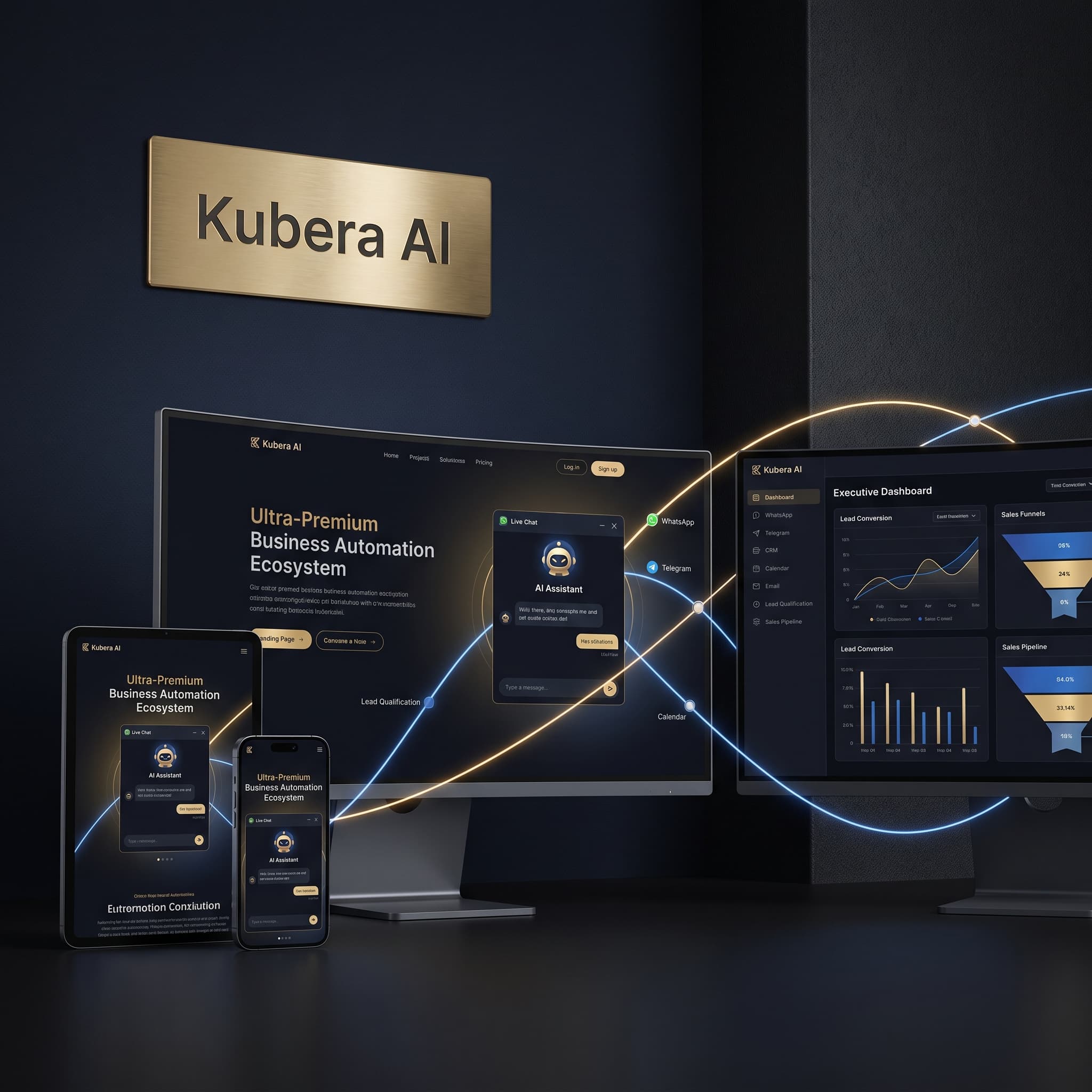
Kubera AI landing page GPT-NTI automation system dashboard

About

About the project

A B2B service provider in Estonia offering specialized professional / consulting services to SMBs, in a category where buyers increasingly research solutions by asking AI assistants directly rather than browsing multiple websites. The company had a standard website with a services page and a contact form — solid SEO fundamentals for traditional Google search, but written in the conventional marketing style (broad claims, no structured direct answers, no FAQ-style content) that AI answer engines have little to extract and cite from.

Starting point

Initial situation

This is a structural gap affecting most small-business websites right now, not a content-quality failure specific to this company:

  • Zero AI-engine visibility: when a prospective buyer asked ChatGPT, Perplexity, or Gemini a question this company was well positioned to answer, the company's own site never surfaced in the answer because the page wasn't structured in a way these engines could extract a confident, citable answer from
  • Low form conversion on the existing page: of visitors who did reach the site, the contact form converted at an estimated 1.5-2.5% — typical for a generic B2B services page with no immediate value exchange
  • No mechanism to capture still-deciding visitors: early-stage B2B visitors want a direct answer before they're willing to hand over contact details, and a static page with a contact form gives them no way to get that answer without committing first

Goal

Project goal

The page wasn't badly designed by traditional standards — it simply wasn't built for either of the two things now driving a growing share of B2B discovery and conversion: AI-engine citation and low-friction, answer-first interaction.

  • Restructure the page so AI answer engines can confidently extract and cite it when a relevant buyer question is asked
  • Replace the form-first conversion model with an AI chat that gives visitors direct, specific answers immediately
  • Track and measure AI-referral traffic separately from traditional search traffic
  • Increase the share of visitors who get a real answer and a next step, rather than bouncing off an unanswered question

Strategy

Automation strategy

Two distinct mechanisms, addressing two different moments in the buyer's journey:

  • Mechanism 1 — AEO / GEO content structuring. The page is rewritten and restructured specifically for extractability: direct-answer sections that state a clear position in the first sentence, explicit comparison and pricing-logic sections, a genuinely useful FAQ section, and schema markup that signals to crawlers exactly what kind of content is on the page.
  • Mechanism 2 — AI sales chat replacing the static form. Instead of a contact form as the only conversion path, an embedded AI chat answers visitor questions directly — pricing logic, process, typical timelines, fit-for-my-situation questions — then naturally transitions a genuinely interested visitor toward booking a call or leaving contact details.
  • Mechanism 3 — Separated traffic tracking. AI-referral traffic is tracked as its own segment, distinct from organic Google search and paid traffic, because its behavior pattern is different enough to need its own conversion benchmark.

Architecture

Workflow architecture

[Content Restructuring: Direct-Answer Sections / FAQ / Comparison Tables / Schema Markup]
        ↓
[Published Page — Crawlable & Citable by AI Engines]
        ↓
   ┌───────────────────┴───────────────────┐
   ↓                                       ↓
[Visitor via AI Engine Citation]    [Visitor via Search / Referral]
   ↓                                       ↓
   └───────────────────┬───────────────────┘
                       ↓
[AI Chat Widget — Answers Direct Questions Using Same Knowledge Base as Page Content]
                       ↓
[Visitor Gets Direct Answer: Pricing Logic / Process / Fit-for-Situation]
                       ↓
[Qualified Interest? → Natural Transition to Booking a Call / Contact Capture]
                       ↓
[CRM Entry: Lead + Source (AI-Referral vs Search vs Direct)]
                       ↓
[Owner Dashboard: AI-Referral Traffic Volume, Chat Engagement Rate, Chat-to-Lead Conversion, Citation Frequency Tracking]

Implemented

What was implemented

  • Full content restructuring of the landing page around direct-answer formatting, structured FAQ, and comparison / pricing-logic sections written for extractability rather than traditional persuasive copy alone
  • Schema markup implementation signaling content type and structure to AI crawlers and traditional search engines simultaneously
  • Embedded AI chat widget trained on the same knowledge base as the page content, answering visitor questions about pricing logic, process, and service fit in real time
  • Natural conversion path within the chat — moving from answered questions to a call-booking or contact-capture step only once the visitor has received genuine value
  • Referral-source tracking distinguishing AI-engine citation traffic from traditional organic and paid traffic
  • Periodic citation-frequency monitoring — checking whether and how the page appears in AI-engine answers for its target questions
  • Owner dashboard tracking AI-referral traffic volume, chat engagement rate, chat-to-lead conversion rate, and traditional form-conversion rate side by side for comparison

Tools / Stack

Tools / Stack

  • n8n (orchestration for chat-to-CRM handoff and tracking)
  • OpenAI / GPT-4o (AI chat conversation engine grounded in the page's own content as its knowledge base)
  • Structured content / schema markup (FAQPage, Service, and Organization schema for AI-crawler and search-engine readability)
  • Analytics layer with referrer-pattern segmentation
  • PostgreSQL (lead CRM + source-attribution tracking)
  • Citation-monitoring process (periodic manual and tool-assisted checks of how the page surfaces in ChatGPT / Perplexity / Gemini responses to target queries)

Economics

Business economics

Modeled on this provider's profile: B2B services to SMBs, existing site with low-converting contact form, and no prior AEO structuring. Every figure below follows a calculation any small B2B service business can re-run on its own traffic volume and average client value.

  • Estimated monthly site visitors (search + referral, pre-project): about 600-800 / month
  • Contact-form conversion rate: about 1.5-2.5% — roughly 10-18 leads / month from the existing traffic
  • At an average client value of about €1,800 and a lead-to-client close rate of about 20-25%, that's roughly 2-4.5 new clients / month from the existing funnel
  • Industry-observed AI chat widgets that provide genuine immediate value often see engagement rates of 25-35% among visitors who interact with the chat, with chat-to-lead conversion 3-5x higher than a static form
  • Applied conservatively to this provider's traffic, that can mean roughly 16-20 leads / month from chat alone, on top of whatever the form still captures
  • Net effect: total monthly leads moving from about 10-18 to an estimated 22-30 / month, without any change in traffic volume
  • Additional client revenue from the measurable near-term lever: roughly €3,600-6,300 / month, generated from existing traffic with no increase in traffic acquisition spend

Results

Expected results

  • Contact-form-only conversion of about 1.5-2.5% supplemented by a chat channel converting higher among engaged visitors
  • Total lead volume increasing by roughly 40-60% without additional traffic spend
  • Page content structured for AI-engine extractability, with citation frequency tracked as an emerging metric
  • Clear separation between AI-referral, organic, and paid traffic in reporting
  • A visible distinction between visitors who get an immediate answer and convert warm, versus visitors who bounce off a page that only offered a form

Value

What the business gets

  • A landing page built for both purposes a B2B page now needs to serve: traditional search visibility and AI-engine extractability
  • A conversion mechanism that meets early-stage researchers where they actually are, wanting an answer, not ready to commit to a callback
  • A genuinely new, separately tracked acquisition channel being built methodically, with realistic expectations about its build-up timeline
  • Source-level attribution clarity, so marketing decisions are based on which channel actually produces clients

Conclusion

Conclusion

A growing share of B2B buyers now ask an AI assistant before they ask Google, and a page written in conventional marketing style simply isn't legible to that audience. Separately, even the visitors who do land on the page the traditional way are being asked to commit to a contact form before they've received a single direct answer. Both problems are solved by restructuring what's already on the page — once to be citable by AI engines, and once to answer the visitor's actual question before asking for anything in return.

CTA

Get a Free Automation Audit

We'll check how your site currently shows up in AI-generated answers to your most common buyer questions — no commitment, no generic pitch.

Get a Free Automation Audit