
AI Internal Operations & Knowledge Automation

The Work Isn't Hard. It's Just Asked and Answered the Same Way, By Hand, Forty Times a Week

Internal Processes

Growing service businesses routinely lose significant management time to repetitive internal coordination — status updates, document requests, onboarding checklists, approval chains — handled manually because no single system ties them together. This scenario outlines how Kubera AI would design an internal-operations automation layer to absorb that coordination load.

Get a Free Automation Audit

Intro

Short intro

Most internal inefficiency doesn't look like a crisis — it looks like a manager answering 'where are we on this?' for the sixth time today, or a new hire waiting two days for someone to remember which document they need next. None of it shows up on a P&L as a line item. All of it adds up to real hours that never touch a client or a deal. This Industry Scenario outlines how Kubera AI would design an internal-operations automation layer for a business carrying this kind of coordination overhead.
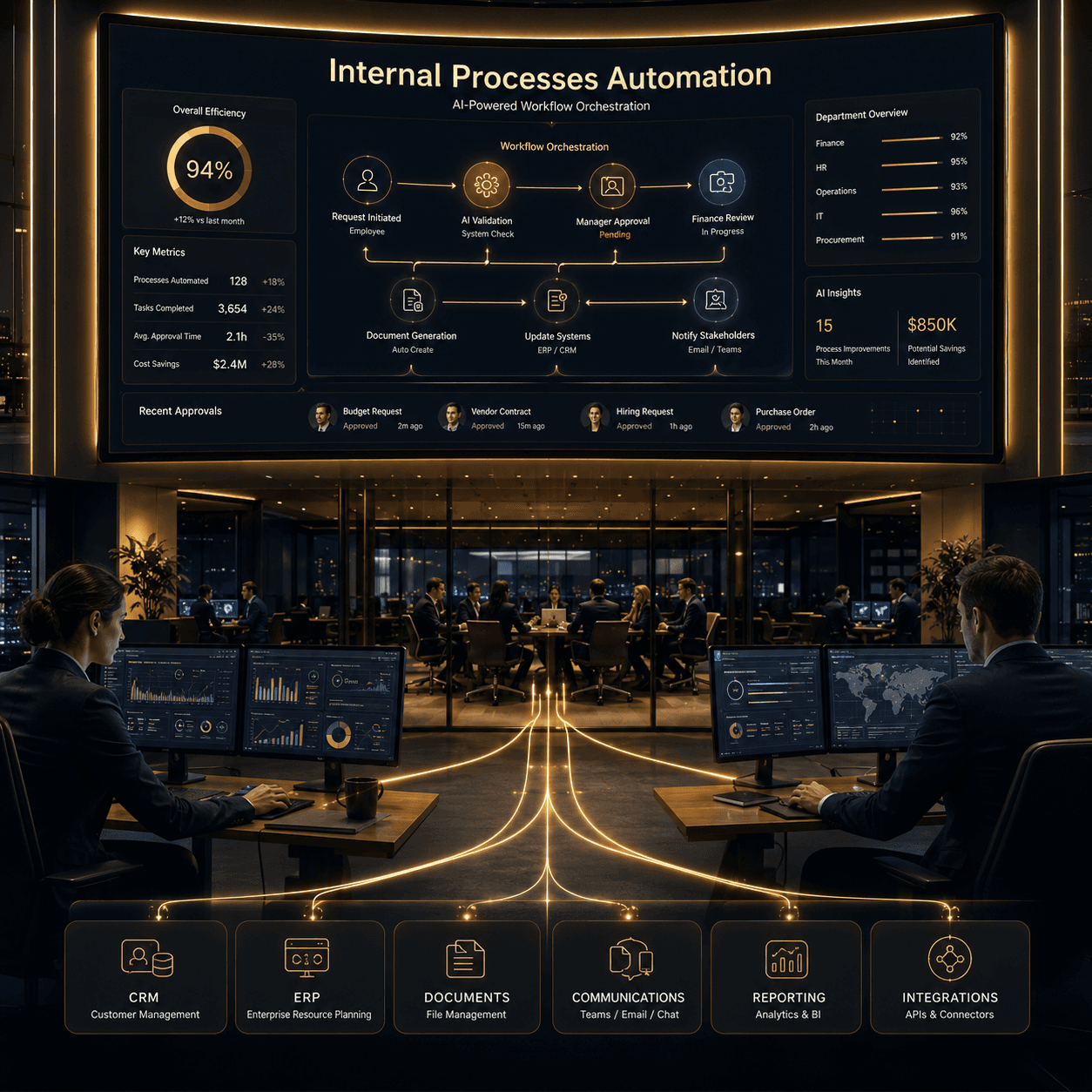
Kubera AI case dashboard for internal process automation

About

About the project

This scenario is modeled on a common profile across professional and operational service businesses: a company of roughly 15-30 staff, organized into 3-5 functional teams, where internal coordination — status checks, document requests, task handoffs between teams, recurring approval steps — is typically handled through a mix of email, Slack / Teams messages, and verbal check-ins, with no single system tracking what's actually pending, with whom, or for how long. This is not a description of a specific client; it represents a structural pattern Kubera AI sees consistently across businesses of this size.

Starting point

Initial situation

This is a structural pattern across growing service businesses once headcount passes roughly 10-15 people — well documented in operations literature, not unique to any one company:

  • Status-check overhead: managers in businesses of this size typically spend an estimated 20-25% of their working time on status inquiries and follow-ups — asking where something stands, chasing an overdue task, or relaying information between two team members who didn't talk to each other directly — none of which is decision-making or value creation, just coordination friction
  • Repetitive document and access requests: new client onboarding, new hire setup, and recurring compliance / admin tasks generate a steady stream of 'can you send me X' requests that are functionally identical each time, but get handled as one-off conversations rather than a standing, self-service process
  • Approval-chain delay: routine approvals that don't require real judgment still pass through the same manual chain as genuinely complex decisions, adding days of latency to low-risk items simply because there's no tier system separating 'needs a human decision' from 'needs a rubber stamp'
  • Tribal knowledge instead of documented process: a meaningful share of 'how do we do X' questions get answered by whichever senior staff member happens to be free, rather than from a documented source — meaning the same question gets answered fresh, slightly differently, multiple times a month, and institutional knowledge stays trapped in a handful of people's heads

Goal

Project goal

For a business matching this profile, the relevant automation objectives would be:

  • Remove repetitive status-check and document-request traffic from managers' and senior staff's direct attention
  • Create a self-service layer for the most common recurring internal requests
  • Separate low-risk routine approvals from genuinely judgment-requiring decisions
  • Capture institutional knowledge into a structured, queryable source instead of leaving it dependent on whoever happens to be available

Strategy

Automation strategy

The core distinction driving this strategy: most internal requests are either informational or procedural — and almost none of them actually require the senior person currently fielding them to personally handle each instance.

  • Layer 1 — Status visibility without asking. Task and project status would be tracked in one system that any team member can query directly — through a chat interface connected to the underlying project / task data — removing the need to interrupt a manager to ask 'where are we on this' when the answer is already structured data sitting in a tool nobody's checking.
  • Layer 2 — Self-service for recurring requests. The most common document, access, and onboarding requests would be converted into a structured request flow: the requester describes what they need through a simple chat or form interface, the system pulls the correct template / checklist / access tier automatically, and routes only genuinely non-standard requests to a human.
  • Layer 3 — Tiered approval routing. Approval requests would be automatically classified by risk / value tier. Low-risk, within-policy items would be auto-approved or fast-tracked with a notification rather than a required action; only items outside policy or above threshold would route to a human decision-maker.
  • Layer 4 — Knowledge capture. Common 'how do we handle X' questions would be captured into a structured internal knowledge base as they're asked, with an AI layer answering repeat questions directly from that base going forward.

Architecture

Workflow architecture

[Internal Request: Status Question / Document Request / Access Request / Approval / "How Do We..." Question]
        ↓
[AI Agent — Classify Request Type]
        ↓
   ┌──────────────┬──────────────┬──────────────┬──────────────┐
   ↓              ↓              ↓              ↓
[Status Query] [Doc / Access   [Approval      [Knowledge
   ↓            Request]       Request]       Question]
[Pull from         ↓              ↓              ↓
 Project / Task   [Auto-Generate [Risk / Value   [Check Knowledge
 System,          from Template   Classification] Base First]
 Answer           + Route if          ↓              ↓
 Directly]        Non-Standard]  ┌────┴────┐    [Found? → Answer
                                ↓         ↓      Directly]
                          [Within     [Outside       ↓
                           Policy →    Policy →  [Not Found? →
                           Auto-       Route to    Route to
                           Approve]    Human]      Human, Then
                                                    Add Answer to
                                                    Knowledge Base]
        ↓
[Internal Dashboard: Request Volume by Type, Auto-Resolution Rate, Average Resolution Time, Manager Time Reclaimed]

Recommendation

Recommended Architecture

  • AI-driven request classification routing every internal inquiry to the correct handling path instead of landing generically in a manager's inbox or chat
  • A direct-query interface connected to the company's existing project / task management data, allowing any staff member to ask 'where are we on X' and receive an immediate, accurate answer without interrupting whoever's actually responsible for it
  • A self-service request flow for the most common recurring document and access needs, auto-generating standard outputs from templates and routing only true exceptions to a human
  • Tiered approval logic auto-clearing low-risk, within-policy requests and routing only above-threshold or out-of-policy items to an actual decision-maker
  • A growing internal knowledge base capturing answers to recurring 'how do we handle X' questions, with an AI layer answering repeat questions directly from that base once it's been built up
  • An internal dashboard tracking request volume by category, auto-resolution rate, average time-to-resolution, and estimated manager / senior-staff hours reclaimed

Tools / Stack

Tools / Stack

  • n8n (orchestration across request types and routing logic)
  • OpenAI / GPT-4o (request classification, knowledge-base Q&A, and document auto-generation)
  • Project / task management system integration for status queries
  • Internal chat platform integration (Slack / Teams, as the primary interface for requests and answers)
  • Document template engine
  • Approval workflow logic with policy-threshold rules
  • PostgreSQL (knowledge base + request-history layer)
  • Internal dashboard for request analytics

Economics

Business economics

This is a conservative, illustrative model based on a company of about 20 staff, with 4-5 people in roles carrying meaningful coordination / management responsibility. The figures below are estimated from industry-standard patterns in operations management research, not from a specific implementation — every business would need to validate these against its own headcount, loaded labor cost, and request volume.

  • Status-check overhead, modeled: at 20-25% of management time spent on status inquiries and coordination chasing, this represents a modeled €1,400-2,200 / week, or €5,600-8,800 / month, in management time spent on coordination friction rather than decision-making or strategic work
  • Removing a conservatively estimated 30-40% of this load would represent a potential €1,700-3,500 / month in redirected management capacity
  • Estimated recurring document / access / onboarding request volume: about 60-80 requests / month across a 20-person company
  • At an estimated 15-20 minutes of staff time per request when handled manually, this represents a modeled 15-25 staff-hours / month spent on requests that are functionally identical each time
  • Deflecting an estimated 60-70% of these to self-service represents a potential 9-17 staff-hours / month recovered, worth approximately €300-650 / month at a blended staff cost of about €30 / hour
  • Routine approvals that currently take an estimated 1-3 days to clear a manual chain could clear in minutes once auto-approved within policy
  • Combined illustrative estimate: roughly €2,000-4,150 / month in internal capacity that this architecture could recover, without adding headcount

Results

Expected results

  • Management time spent on status inquiries and coordination chasing reduced by an estimated 30-40%
  • 60-70% of recurring document / access / onboarding requests handled through self-service, with only genuine exceptions reaching a human
  • Routine, within-policy approvals clearing in minutes rather than days
  • A growing internal knowledge base that may reduce repeat 'how do we do X' questions over time
  • An internal dashboard giving leadership visibility into where coordination time is actually going

Value

What the business gets

  • A structural reduction in coordination overhead that scales with headcount, without proportionally scaling the management layer needed to absorb it
  • A self-service layer for the requests that are genuinely repetitive, freeing senior staff attention for the requests that genuinely need it
  • A faster approval process for low-risk decisions, without removing human judgment from decisions that actually require it
  • Institutional knowledge that survives staff turnover and time off, instead of being concentrated in whichever senior person happens to remember the answer
  • Visibility into internal operational friction that's normally invisible until it's acute — measured and addressable rather than just felt

Conclusion

Conclusion

This architecture is most appropriate for service businesses that have grown past the point where informal, ad hoc coordination still works — typically once headcount passes 10-15 people and a meaningful share of management time visibly shifts from decision-making to status-relaying. Kubera AI recommends this approach because the underlying problem — repetitive, low-judgment coordination work consuming senior staff time — is structurally separable from genuine decision-making, and separating the two doesn't require replacing any existing system, only connecting them through a classification and routing layer. Businesses earlier than this growth stage typically don't yet generate enough repetitive internal request volume to justify the build; businesses well past it, with dedicated operations or business-systems staff already in place, may have already solved parts of this informally and would benefit most from the approval-tiering and knowledge-capture layers specifically, rather than the full architecture.

CTA

Get a Free Automation Audit

We'll map your internal request volume and approval patterns against this scenario — no commitment, no generic pitch.

Get a Free Automation Audit