
AI Order Processing & Inventory Sync System

The Customer Didn't Leave Because of Your Price. They Left Because "In Stock" Turned Out to Mean "Maybe"

E-commerce & Logistics

Most small online stores lose sales two ways: customers who abandon their cart because shipping and stock info isn't clear, and orders that get delayed because stock numbers in the system don't match what's actually on the shelf. This scenario shows how Kubera AI would design a system that keeps inventory accurate in real time and handles order questions before a customer gives up and leaves.

Get a Free Automation Audit

Intro

Short intro

A shopper adds something to their cart, checks out, and gets an email two days later saying it's actually out of stock. They don't come back. Multiply that by every order where the warehouse count and the website count quietly drifted apart, add a support inbox full of "where's my order" emails that all needed the same five-minute answer, and you've got a store losing money on orders it already won — not on traffic, not on price, just on follow-through. This Industry Scenario shows how Kubera AI would design the system that closes that gap.
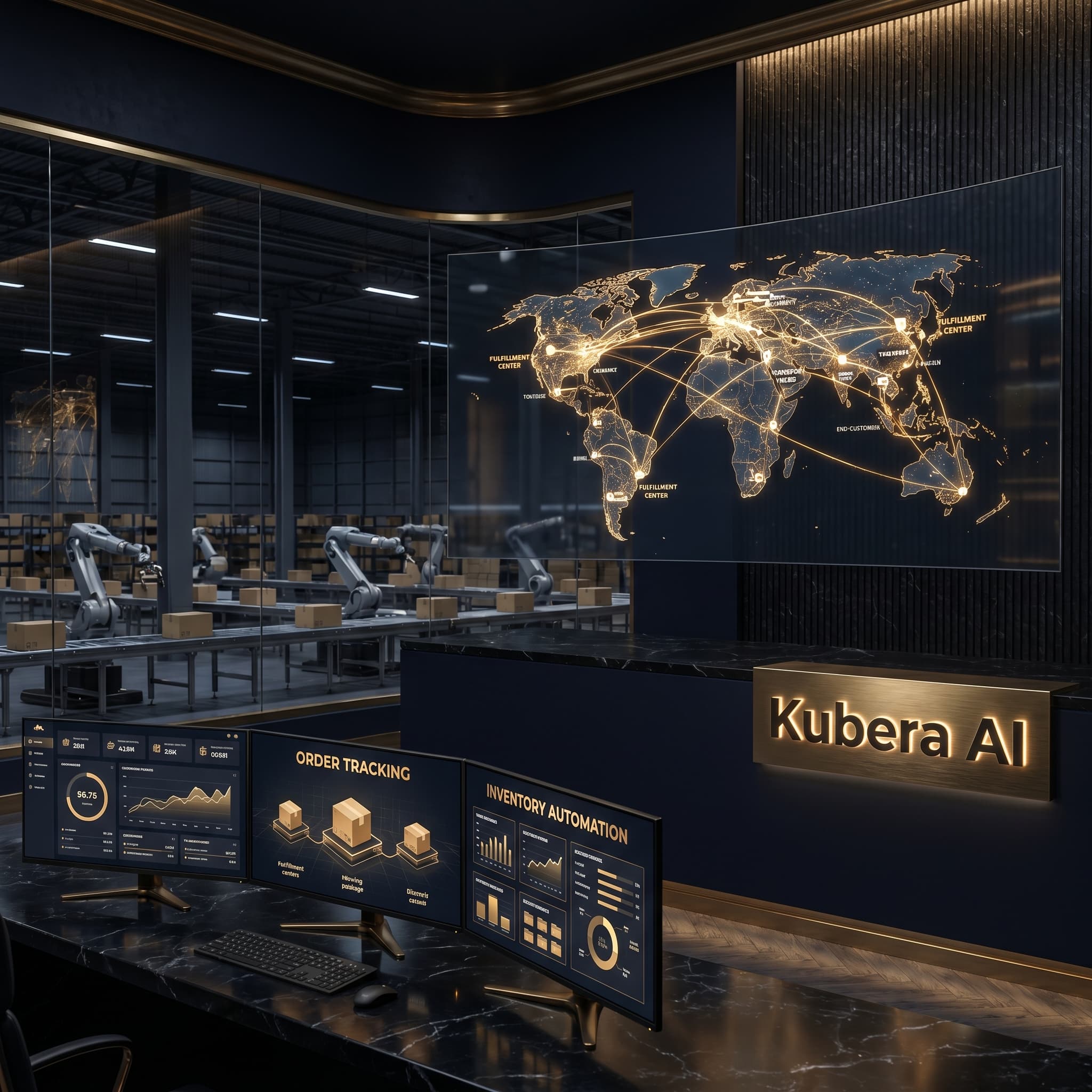
Kubera AI case dashboard for e-commerce and logistics automation

About

About the project

This scenario is built around a small to mid-size online store selling physical products — anywhere from 200 to a few thousand SKUs, running on a platform like Shopify or WooCommerce, shipping through one or two carriers, with one or two people handling order processing, customer questions, and inventory updates by hand. This isn't a description of one specific client. It's the pattern Kubera AI sees across most online stores that have grown past a side-project volume of orders but don't yet have a dedicated operations team.

Starting point

Initial situation

None of what follows is a sign of bad management. It's a structural pattern, and it shows up almost identically across stores at this stage:

  • Stock counts drift from reality. Inventory gets updated manually, or synced loosely between a warehouse system and the storefront, which means the number shown online and the number actually on the shelf disagree more often than anyone realizes — until a customer orders something that isn't there, or a product sits marked "out of stock" online for days after new units have already arrived.
  • Cart abandonment is highest exactly where it's most fixable. Industry benchmarks on cart abandonment across e-commerce consistently sit in the 65–75% range, and unclear shipping costs, vague delivery timing, and uncertain stock status are repeatedly cited among the top reasons shoppers give up at checkout — not price, not product fit, just not knowing what they're actually getting and when.
  • Order status questions repeat the same five answers all day. "Where's my order," "can I change my address," "when will this ship," and "is this back in stock" make up the large majority of a typical store's support volume — each one answerable in seconds if the answer comes from the order/shipping system directly, but currently requiring someone to open the order, check the carrier, and type a reply by hand.
  • Returns and exchanges run on email, not a process. Without a structured flow, a return request usually means several email exchanges to confirm eligibility, generate a label, and update inventory once the item comes back — adding days of delay and a meaningful amount of staff time to something that, for an eligible return, should be a two-minute interaction.

Goal

Project goal

None of this means the store is being run badly. It means a meaningful share of daily operations is repetitive status-checking and data syncing dressed up as customer service and inventory management — and neither of those actually needs to be done by hand.

  • Keep stock counts accurate across the storefront and the actual warehouse in real time, so "in stock" online means in stock for real
  • Reduce cart abandonment driven by unclear shipping, delivery, or stock information at checkout
  • Answer the most common order-status questions instantly, without a human reading and typing the same five answers all day
  • Turn returns and exchanges into a structured, fast process instead of an email back-and-forth

Strategy

Automation strategy

The core idea: most of what slows down a small e-commerce operation is information that already exists somewhere in the system — current stock level, shipping status, return eligibility — just not connected to where the customer or the team needs to see it. Connecting that information removes the manual checking, typing, and waiting that currently stands in for a process.

  • Step one — inventory that actually matches reality. Stock levels would sync automatically between the warehouse/inventory system and the storefront, so a sale anywhere updates the count everywhere, and a restock shows up online the moment it's logged — removing the gap between what's written down and what's actually on the shelf.
  • Step two — clear answers at checkout, before the cart gets abandoned. Real shipping costs, accurate delivery timing, and current stock status would be shown at checkout based on live data, not estimates — closing the most commonly cited reasons shoppers abandon a cart before completing a purchase.
  • Step three — instant answers to the questions that repeat every day. A customer asking about order status, shipping timing, or stock availability would get an immediate, accurate answer pulled directly from the order and inventory systems — through chat, email, or WhatsApp — with only genuinely unusual requests reaching a human.
  • Step four — returns that run on a process, not an inbox. An eligible return request would trigger an automatic flow: eligibility check against the order date and product type, a shipping label generated, and inventory updated automatically once the item is scanned back in — turning a multi-day email thread into a same-day, mostly self-service process.

Architecture

Workflow architecture

[Warehouse/Inventory System]
        ↕ (Real-Time Sync)
[Storefront Stock Display — Shopify/WooCommerce]
        ↓
[Checkout: Live Shipping Cost + Delivery Estimate + Stock Status]
        ↓
[Order Placed]
        ↓
[Customer Question: Order Status / Shipping / Stock]
        ↓
[AI Agent — Pulls Live Data from Order/Shipping System]
        ↓
   ┌───────────────┴───────────────┐
   ↓                               ↓
[Answerable Directly]      [Genuine Exception —
   ↓                         Routed to Human]
[Instant Reply: Status, Tracking, ETA]

[Return Requested]
        ↓
[Eligibility Check — Automatic]
        ↓
[Label Generated + Sent to Customer]
        ↓
[Item Scanned Back In → Inventory Updated Automatically]
        ↓
[Owner Dashboard: Stock Accuracy, Cart Abandonment Rate, Support Volume Deflected, Average Return Turnaround]

Recommendation

Recommended Architecture

  • Real-time inventory sync between the warehouse/inventory system and the storefront, so stock numbers match across both at all times instead of drifting apart between manual updates
  • Live checkout information pulling real shipping costs, delivery estimates, and stock status into the checkout flow, instead of generic or outdated placeholders
  • An AI support layer answering order-status, shipping, and stock questions directly from live order data, across chat, email, and WhatsApp, with exceptions routed to a human
  • An automated returns flow that checks eligibility, generates a shipping label, and updates inventory automatically once a returned item is received — without a multi-email exchange for every request
  • A dashboard tracking stock accuracy, cart abandonment, how much support volume is being handled without a human, and how long returns actually take from request to resolution

Tools / Stack

Tools / Stack

  • n8n (orchestrates inventory sync, order monitoring, and return workflows)
  • OpenAI / GPT-4o (customer question handling, grounded in live order/shipping/inventory data)
  • E-commerce platform integration (Shopify, WooCommerce, or comparable)
  • Inventory/warehouse management system integration (syncing stock counts bidirectionally)
  • Shipping carrier API integration (live tracking data and label generation for returns)
  • WhatsApp Business API + email (customer communication channels)
  • PostgreSQL (order history and returns-tracking layer)
  • A dashboard for stock accuracy, abandonment, and support metrics

Economics

Business economics

This is a conservative model based on a store processing an estimated 300–600 orders a month, with one or two people handling support and inventory manually. The numbers below come from publicly available e-commerce benchmarks on cart abandonment, support volume, and returns handling — not from a specific client. Every store should check these against its own order volume and average order value before relying on them.

  • Industry-wide cart abandonment rates commonly sit around 65–75%, with unclear shipping/delivery/stock information cited among the leading reasons, alongside unexpected costs and a complicated checkout flow.
  • For a store with, say, 2,000 monthly checkout starts and a 70% abandonment rate, that's roughly 1,400 abandoned carts a month. Even a conservative estimate that 5–8% of abandonment is specifically attributable to unclear shipping/stock information that this system would directly fix — rather than price or product fit, which automation doesn't touch — represents an estimated 70–110 recoverable orders a month.
  • At an average order value of €45, recovering even half of that estimated segment represents a modeled €1,575–2,475/month in recovered revenue — a conservative, illustrative figure dependent entirely on the store's actual average order value and current checkout experience.
  • Order-status, shipping, and stock questions commonly make up an estimated 40–60% of total support volume for a store this size — a reasonable estimate for a store seeing roughly 150–250 support contacts a month puts repetitive status questions at 60–150 contacts/month.
  • At an estimated 4–6 minutes per manual reply (opening the order, checking the carrier, typing a response), that's roughly 4–15 hours/month spent answering questions that are answerable instantly from data the system already has.
  • At a support labor cost of roughly €15–20/hour, deflecting an estimated 70–80% of these to automated, instant answers represents a potential €40–180/month in freed-up support time — modest on its own for a smaller store, but scaling directly with order and support volume as the store grows.
  • A manually handled return commonly takes an estimated 15–20 minutes of staff time spread across several touchpoints, compared to a largely self-service flow that needs only occasional human review.
  • For a store processing an estimated 20–40 returns a month, automating the eligible-return flow could reasonably free up roughly 5–13 hours/month of staff time — worth approximately €75–195/month at the same support labor cost.

Results

Expected results

  • Stock numbers that match between the warehouse and the storefront in real time, instead of drifting apart between manual updates
  • A measurable reduction in cart abandonment tied specifically to unclear shipping, delivery, or stock information at checkout
  • The large majority of order-status, shipping, and stock questions answered instantly without a human typing a reply
  • Returns that move from a multi-day email thread to a largely same-day, self-service process for eligible requests
  • A dashboard giving the owner visibility into stock accuracy, abandonment, and support volume instead of relying on a general sense that "things feel slow sometimes"

Value

What the business gets

  • Inventory numbers the team can actually trust, instead of double-checking the warehouse before promising stock to a customer
  • Fewer abandoned carts caused by the parts of checkout that are entirely within the store's control to fix
  • A support inbox that isn't dominated by questions the system already has the answer to
  • A returns process that's fast enough to keep a disappointed customer instead of losing them twice — once on the return, once for good
  • Operations that scale with order volume without requiring proportional headcount growth in support and inventory management

Conclusion

Conclusion

This setup makes the most sense for a store that's grown past the point where one person checking the warehouse and answering emails by hand still keeps up — usually somewhere past a few hundred orders a month, where stock discrepancies start happening regularly and the support inbox starts feeling permanently behind. The tell is usually a product going out of stock online after it's already been restocked, a "where's my order" email volume that takes up a visible chunk of someone's day, or a return process that depends on remembering which emails are still waiting for a reply. Kubera AI recommends this approach because e-commerce operations data is unusually well suited to real-time automation: stock levels, order status, and shipping data already exist as structured information the moment an order is placed — the gap is purely in connecting that data to where customers and staff actually need to see it. A store with very low order volume (a few dozen a month) likely wouldn't see proportional value here relative to the setup effort; a store already running a mature operations stack with tight inventory sync may only need the checkout-information and support-deflection pieces of this, not the full system.

CTA

Get a Free Automation Audit

Want to know how much cart abandonment and support time your store might be losing to information gaps? We'll map your order volume and current checkout setup against this scenario — no commitment, no generic pitch.

Get a Free Automation Audit

Related use cases

Adjacent use case pages

These links keep the case study connected to the new use-case cluster without claiming the same project or client.