AI Booking, Retention & Upsell System

The Real Money in Beauty Clinics Isn't the First Visit — It's the Fifth One You Never Asked For

Beauty & Health

A beauty clinic was filling appointments manually and losing repeat clients to silence between visits. We built an AI system that books, reminds, and re-engages clients automatically — turning one-time visits into recurring revenue.

Get a Free Automation Audit

Intro

Short intro

Beauty and aesthetic clinics rarely lose money on lead generation — Instagram and referrals usually bring enough new faces through the door. They lose money on what happens after the first visit: clients who liked the result, meant to come back, and simply never did because nobody followed up. This case is about closing that specific gap.
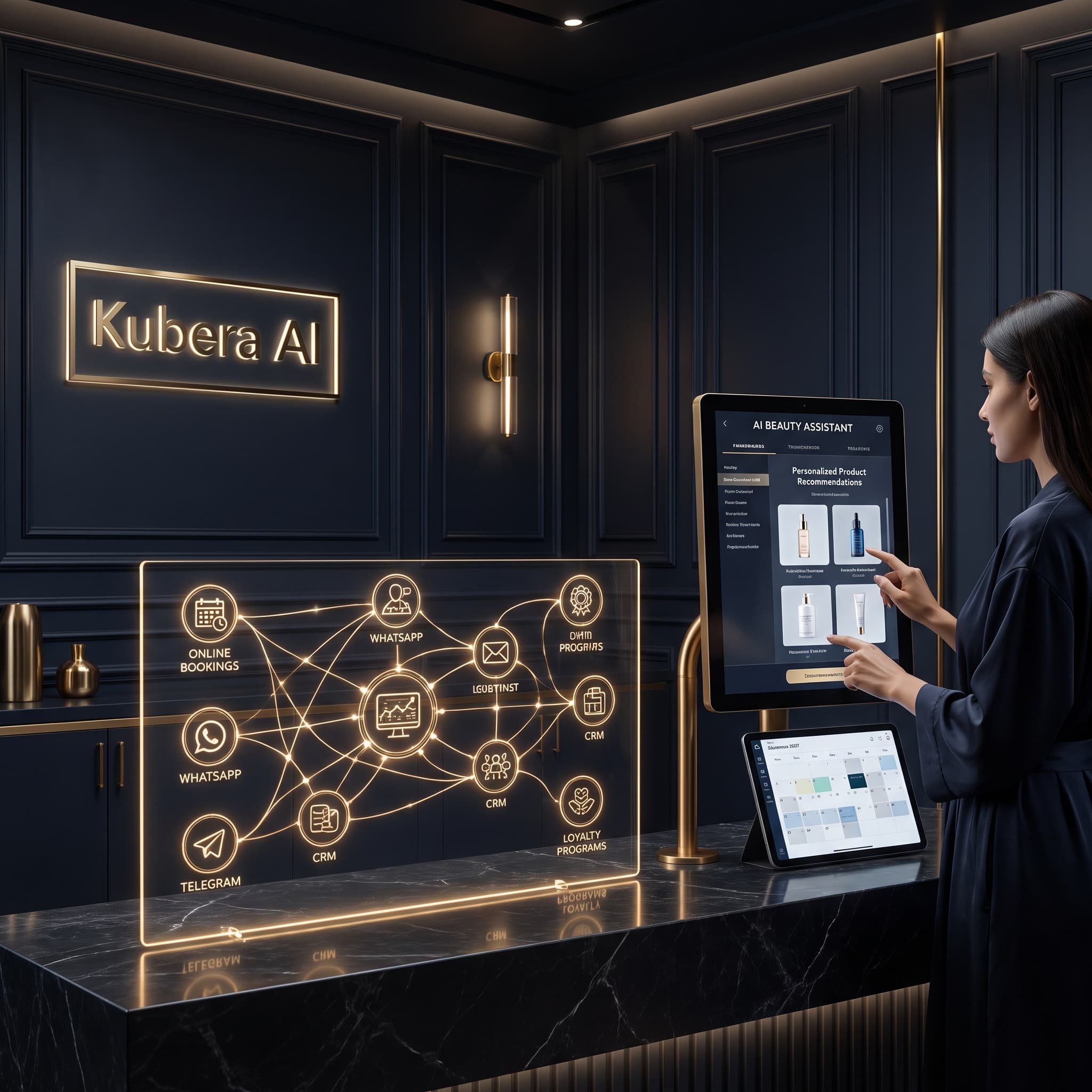
Kubera AI case dashboard for beauty and health automation

About

About the project

A beauty clinic in Latvia offering a mix of facial treatments, laser hair removal courses, and cosmetology procedures — 2 treatment rooms, 4 specialists, front desk handling bookings via phone, Instagram DM, and a basic online form. The clinic had steady new-client flow from social media but no structured process for re-booking, course completion tracking, or reactivating clients who'd gone quiet.

Starting point

Initial situation

Like most clinics of this profile, there was no CRM — client history lived in the heads of specialists and a paper or spreadsheet appointment log. We mapped the gap using standard patterns for this business model:

  • Laser hair removal and similar treatments are sold as courses (typically 6–8 sessions), but without active follow-up, course completion rates in the industry average only 55–65% — meaning roughly a third of pre-paid or partially-paid clients simply stop coming
  • Single-treatment clients (facials, peels) have a natural re-booking cycle of 4–6 weeks, but without a reminder, return rates drop to 20–30% instead of the achievable 50–60%
  • Inbound Instagram DMs and booking inquiries were checked manually 2–3 times a day, creating response delays of several hours — long enough for a price-sensitive client to book elsewhere

Goal

Project goal

This isn't a traffic problem. It's a retention and follow-through problem, and in beauty/aesthetics, retention is where the margin actually lives — repeat clients cost nothing to acquire twice.

  • Respond to every inquiry (Instagram, web, phone) within minutes, not hours
  • Track course progress per client and automatically prompt the next session
  • Re-activate clients who've gone silent for 6+ weeks with a structured, non-spammy outreach sequence
  • Give the owner visibility into rebooking rate, course completion rate, and revenue per client — none of which existed before

Strategy

Automation strategy

The core insight: in beauty clinics, the booking itself is rarely the hard part — clients who come back already trust the brand. The hard part is remembering to ask them back at the right moment, and beauty businesses do this manually, inconsistently, or not at all.

  • Stage 1 — Acquisition capture. Every new inquiry from Instagram, web form, or phone is logged, qualified, and booked through the same AI flow — no channel left to manual checking.
  • Stage 2 — Course tracking. For multi-session treatments, the system tracks sessions completed vs. sessions remaining and auto-prompts the next booking at the clinically appropriate interval (e.g., 4 weeks for laser), instead of relying on the client to remember.
  • Stage 3 — Single-treatment recall. For facials/peels with a natural 4–6 week cycle, clients get a "ready for your next session" message timed to that window — before they forget the clinic exists.
  • Stage 4 — Win-back. Clients with no booking in 8+ weeks enter a separate, lighter-touch sequence (not a hard sell — a check-in + an easy rebooking link) distinct from active-client reminders.

Architecture

Workflow architecture

[Inbound: Instagram DM / Web Form / Phone]
        ↓
[AI Agent — Qualify + Match to Service/Specialist]
        ↓
[Calendar Check → Book or Offer Alternatives]
        ↓
[CRM Entry: Client Profile + Treatment + Course Plan]
        ↓
   ┌──────────────┴──────────────┐
   ↓                             ↓
[Multi-session Course]    [Single Treatment]
   ↓                             ↓
[Auto-prompt next session  [Recall message at
 at correct interval]       4-6 week mark]
   ↓                             ↓
   └──────────────┬──────────────┘
                  ↓
        [No booking in 8+ weeks?]
                  ↓
        [Win-back sequence: check-in + rebooking link]
                  ↓
        [Owner Dashboard: rebooking rate, course
         completion rate, revenue per client]

Implemented

What was implemented

  • AI agent handling Instagram DM, web inquiries, and phone booking with real-time calendar sync
  • Course tracker: every multi-session treatment logged with sessions used/remaining, auto-triggering the next booking prompt
  • Recall automation for single treatments based on each treatment's typical re-booking cycle (not a one-size-fits-all reminder)
  • Win-back sequence for clients inactive 8+ weeks, separate tone and cadence from active reminders
  • CRM layer storing full client history: treatments received, specialist seen, spend to date
  • Owner dashboard: new vs returning client ratio, course completion %, average revenue per client, busiest hours by specialist

Tools / Stack

Tools / Stack

  • n8n (orchestration)
  • OpenAI / GPT-4o (conversation + intent matching)
  • Instagram/Meta Business API
  • WhatsApp Business API
  • Google Calendar or clinic booking software integration
  • PostgreSQL (CRM + course tracking)
  • SMS gateway (reminder delivery)

Economics

Business economics

Modeled on this clinic's profile (2 rooms, 4 specialists, course-based services) — the value isn't in one big number, it's in three separate, stackable leaks that most clinics never measure individually.

  • Leak 1 — Course drop-off: assume ~40 active multi-session courses running at any time, average course value ~€350 (6–8 sessions). Industry-typical completion without follow-up: ~60% → with structured prompts: ~80%. That 20-point gap on 40 courses = ~8 additional completed courses/month → ~€2,800/month in course revenue that was being left unfinished, not unsold.
  • Leak 2 — Single-treatment re-booking: ~150 single-treatment clients/month (facials, peels), natural re-booking cycle 5 weeks. Re-booking rate without recall: ~25% → with timed recall message: ~50%. That's roughly 35 additional re-bookings/month at an average ticket of ~€60 → ~€2,100/month in recovered repeat visits.
  • Leak 3 — Response speed on new inquiries: manual DM checking 2–3x/day vs. instant AI response — industry data consistently shows inquiry-to-booking conversion drops sharply (commonly by half or more) once response time exceeds ~10 minutes. Even a conservative 15–20% lift on new-inquiry conversion adds a meaningful and measurable monthly increment — the exact figure depends on the clinic's actual inquiry volume and is worth measuring in month one rather than estimating in advance.
  • Combined, the course and recall leaks alone represent roughly €4,500–5,000/month in revenue the clinic was already capable of earning from clients it already had — before counting any new-client growth at all.

Results

Expected results

  • Course completion rate up from ~60% to ~75–80% within the first 2–3 months
  • Single-treatment re-booking rate roughly doubling (25% → ~50%) once recall timing is tuned to each treatment type
  • Inquiry response time down from hours to minutes across Instagram, web, and phone
  • Win-back sequence reactivating a measurable share of dormant clients monthly (typically 10–15% of those contacted return within the sequence)
  • Owner dashboard replacing guesswork with actual numbers: which specialist drives the most repeat business, which treatment has the weakest completion rate, where the real revenue sits

Value

What the business gets

  • A retention engine, not just a booking bot — the system's real job is making sure paid courses get finished and happy clients come back
  • Full client history in one place instead of fragmented memory across 4 specialists
  • A measurable, segment-specific recall strategy instead of one generic "we miss you" message sent to everyone
  • Owner-level visibility into the metrics that actually predict revenue: completion rate, rebooking rate, revenue per client — not just "how many DMs did we get this week"

Conclusion

Conclusion

Beauty clinics rarely have a marketing problem — they have a memory problem. Clients who already trust the brand and already paid for a course quietly stop coming because nobody reminded them at the right moment. That's not lost demand, it's unfinished revenue the clinic already earned the right to collect. Structuring the follow-up — by treatment type, by timing, by client status — turns that unfinished revenue into a predictable monthly number instead of a guess.

CTA

Get a Free Automation Audit

Want to see how much unfinished revenue is sitting in your client list? We'll map your course completion and re-booking rates against industry benchmarks — no commitment.

Get a Free Automation Audit

Related use cases

Adjacent use case pages

These links keep the case study connected to the new use-case cluster without claiming the same project or client.